
Add-ons
Based on XMapTools 4.5 embedded documentation – Help file version 09.06.2026
This page describes the tools available in the Add-ons section. Contact Pierre Lanari if you want to develop an add-on for XMapTools.
Export
This module allows XMapTools data to be exported. It is available for both Map Data and Spot Data.
The export format is defined by the user and can be used to export data for a specific software (e.g. MinPlot). Select the Data source, a maskfile and the type of data to be exported (e.g. Median, Mean or random selection, see Fig. 1).
The BRC correction is a correction from XMapTools 4.3 (Lanari et al. 2019) that eliminates mixing pixels using the maskfile data.
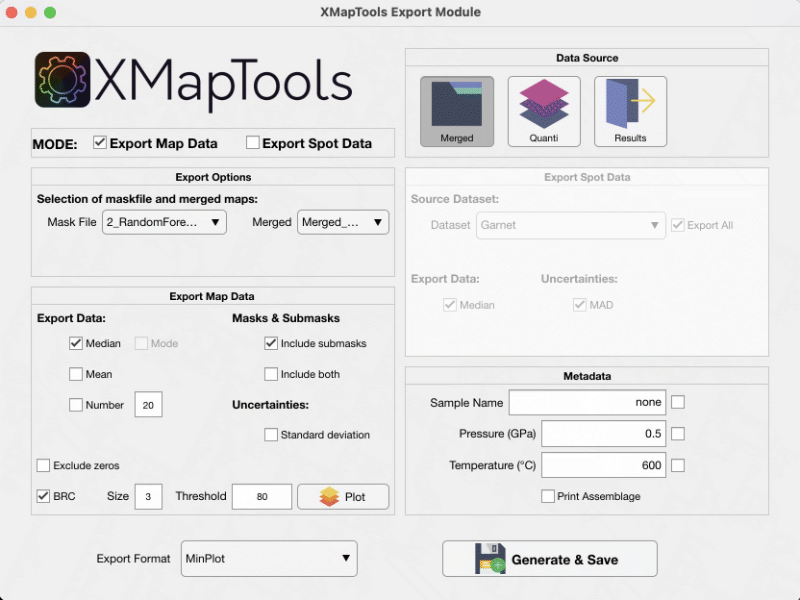
Figure 1: Export module for Map Data in XMapTools 4.5.
Spot data can be exported using the Export module available in the Add-on section. Open the module and select the Export Spot Data mode. Select your data source (e.g. Quanti in Fig. 2) and press the Generate & Save button.
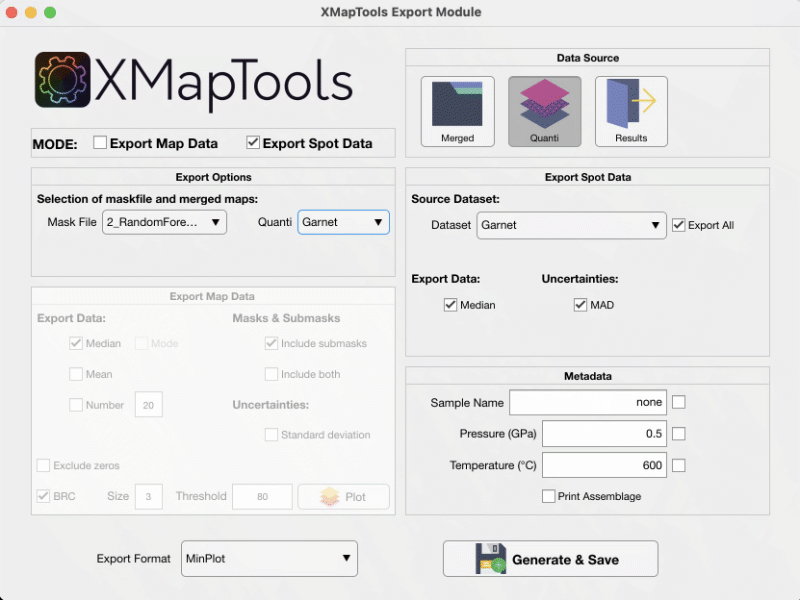
Figure 2: Export module for Spot Data in XMapTools 4.5.
IMG Converter
The image converter module allows images to be converted to numeric data. Press the Load Image button to load an image. The image can be cropped by using the pink ROI and clicking the Crop Image button. The min and max values can be set manually (e.g. 0 and 100 in Fig. 3). Press the Save Map button to save the converted data into a txt file.
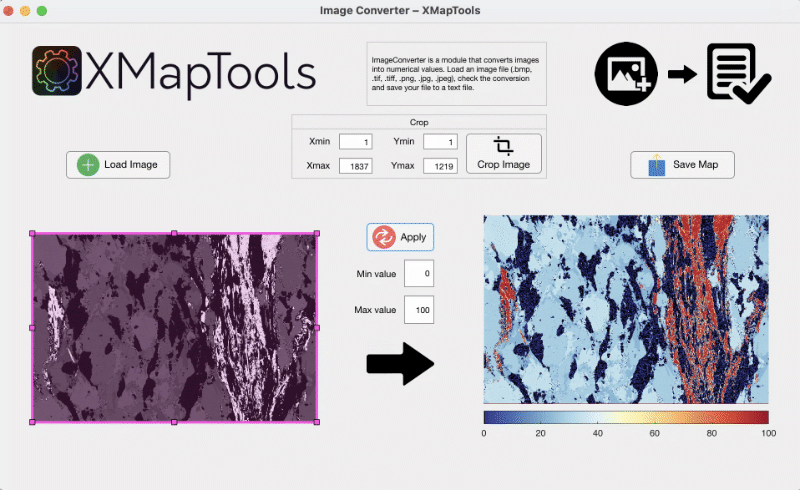
Figure 3: Image Converter module.
Bingo-Antidote
Bingo-Antidote is a petrological software originally developed by Pierre Lanari and Erik Duesterhoeft that offers an alternative modelling strategy based on iterative thermodynamic models integrated with quantitative compositional mapping. Bingo-Antidote 2.0 is distributed as an add-on to XMapTools. It comes with a redesigned graphical user interface and improved functionality.
Visit https://xmaptools.ch/bingo-antidote/ to find out more. See also the dedicated Bingo-Antidote documentation page.